If you buy European hardwood for flooring, furniture, or structural projects, you know that choosing the right grades makes all the difference in performance, price, and finish. This guide explains—in plain language—how to interpret the most widely used market grades: QF1a–QF5 boards (European oak), QPA/QP1A beams, and A/B/C friezes/squares. You’ll see when fixed or random widths make sense, which thicknesses are most common (e.g., boards 20–80 mm and lengths 1000–3500 mm), and how to order exactly what you need for your application. At FGP Hardwood we work with these families and grades daily, with international supply and an FSC and PEFC option.
1. European Oak Boards: QF1a–QF5
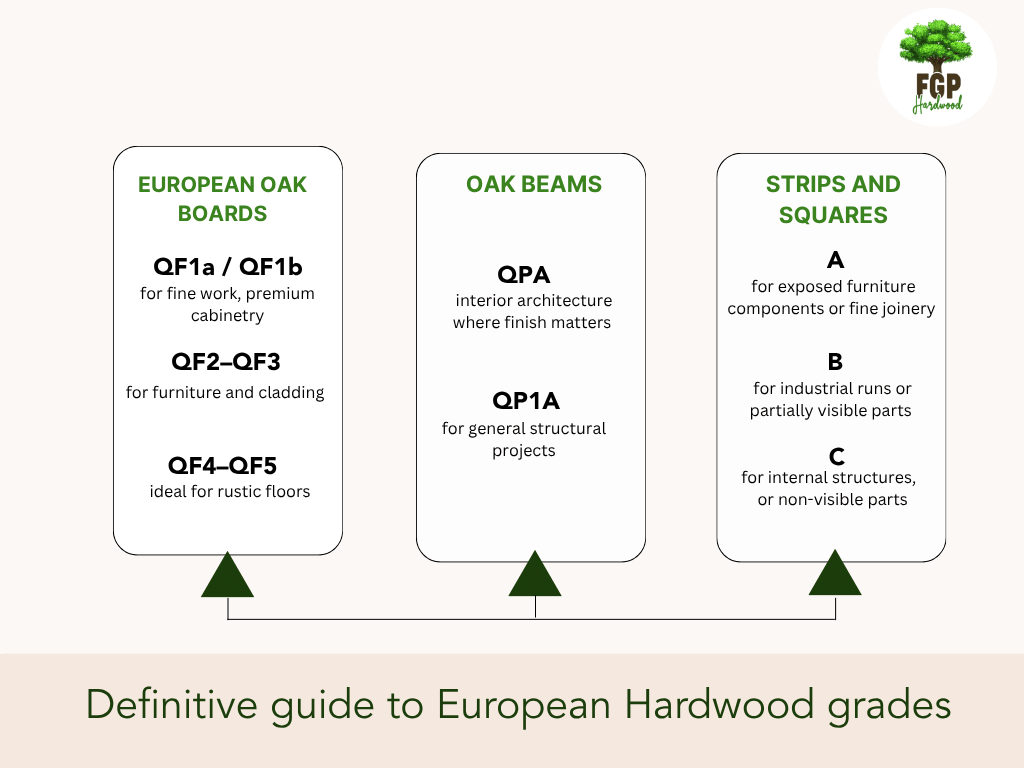
When we talk about European oak in sawn boards, the QF1a–QF5 range describes appearance and selection level: the lower the number/letter, the higher the grade.
- QF1a / QF1b: very high selection for fine work (exposed panelling, premium cabinetry).
- QF2–QF3: excellent balance of aesthetics and yield for furniture and cladding.
- QF4–QF5: greater tolerance for knots/variation; ideal for rustic floors, character projects, or where cost and yield are the priority.
2. Oak Beams: QPA and QP1A
For oak beams (e.g., 150×150, 200×200, 100×100), QPA and QP1A are used as reference grades for projects requiring stability, strength, and visual uniformity.
- QPA: superior selection for exposed structures or interior architecture where finish matters.
- QP1A: technical standard with an excellent balance of functionality and aesthetics for general structural projects.
3. Friezes and Squares: A/B/C Grades
In friezes and squares (for example, 50×50, 38×38, 27×50, 27×60, 27×65), A/B/C grades indicate selection level for smaller parts or components:
- A: very uniform appearance; recommended for exposed furniture components or fine joinery.
- B: price–appearance balance for industrial runs or partially visible parts.
- C: greater tolerance for knots/variation; excellent for internal structures, battens, or non-visible parts.
4. European Beech and Ash: ranges and recommended uses
Although European oak drives most demand, European beech and European ash are key allies for their stability, workability, and finishing capability:
- European beech: uniform grain, excellent dimensional stability; available 27–80 mm, random widths, A/B/C grades. Ideal for furniture, panelling, and components requiring precision and homogenous finishes.
- European white ash: straight grain, great workability, and good durability; available 27–80 mm, random widths, A/B/C grades. Recommended for flooring, cladding, and design furniture thanks to its light, versatile look.
5. Checklist for placing your order
Before confirming, define and share with your supplier:
- Species: oak, beech, or ash (and whether you need FSC®) or PEFC.
- Format: boards, beams, strips/squares.
- Grade: QF1a–QF5, QPA/QP1A, or A/B/C as applicable.
- Dimensions: thickness (e.g., 20–80 mm for boards), width (fixed or random), and length (1000–3500 mm).
- Volume and tolerances: specify acceptable ranges for knot/colour/sapwood according to use.
- Lead times: remember kiln drying and logistics affect delivery date; plan ahead.
6. How to choose the right grade for your application
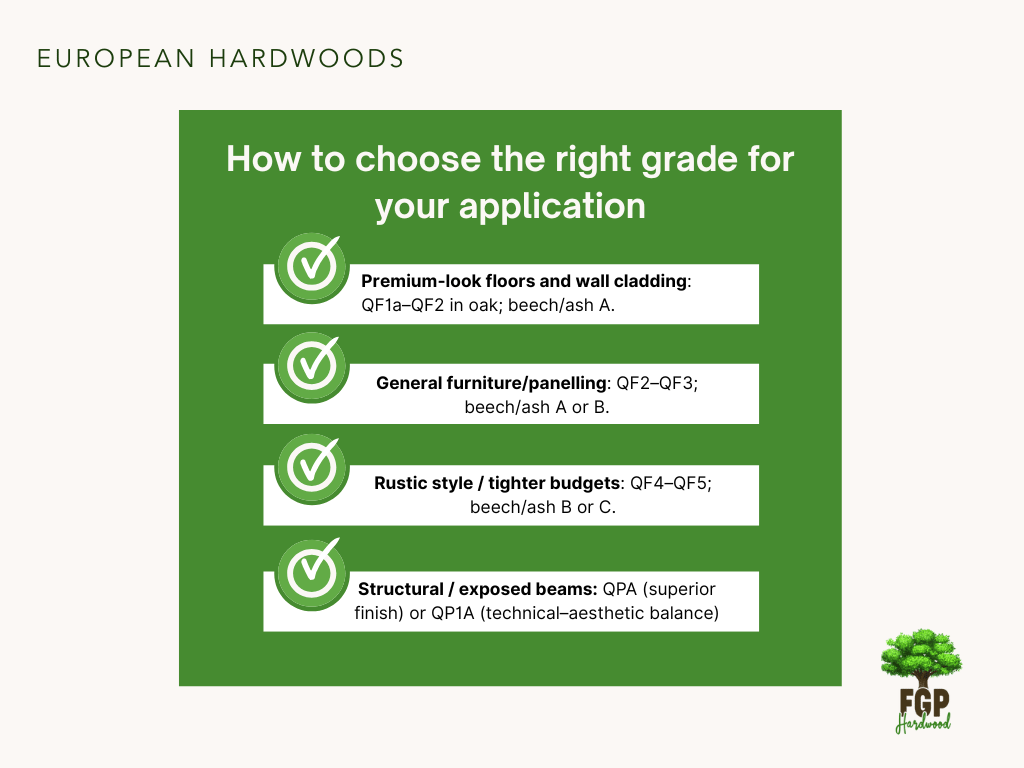
- Premium-look floors and wall cladding: QF1a–QF2 in oak; beech/ash A.
- General furniture/panelling: QF2–QF3; beech/ash A or B.
- Rustic style / tighter budgets: QF4–QF5; beech/ash B or C.
- Structural / exposed beams: QPA (superior finish) or QP1A (technical–aesthetic balance).
Choosing the right grade secures the technical and aesthetic success of your project and optimizes total cost. With this guide you can now compare QF1a–QF5, QPA/QP1A, and A/B/C and order exactly what you need: species, 20–80 mm boards, fixed or random widths, 1000–3500 mm lengths, and the grade suited to your application.
At FGP Hardwood we help you define grades, size your order, and meet deadlines, with an FSC® or PEFC option and international supply. Tell us your dimensions and grades and we’ll propose the best quality–price–lead time combination for your case.
If you want to know more about the world of wood, don't forget to follow us on Linkedin. Stay informed!