
In recent years, the construction industry has undergone a significant transformation, with European hardwood emerging as a material of renewed prominence. Renowned for its timeless aesthetics, structural performance, sustainability, and versatility, European hardwood is increasingly favored in contemporary architecture and design.
As a company specializing in European hardwoods, we’ve identified several key trends redefining the use of these materials in modern construction.
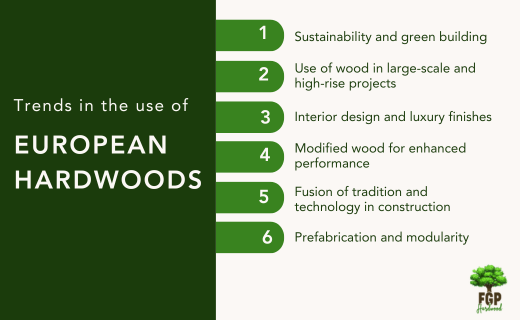
1. Sustainability and green building
The rise of sustainable construction has fueled growing interest in European hardwoods as a renewable resource. Countries like Germany and France lead in sustainable forest management, ensuring that logging is balanced with reforestation. This makes woods such as European oak, ash, and chestnut preferred options for eco-friendly projects. Architects and builders value these hardwoods not only for their beauty and durability but also for their low environmental impact.
Key trend: Sustainable certification (FSC, PEFC) is becoming a decisive factor in selecting European hardwoods for construction projects, as consumers and builders increasingly prioritize materials that reduce the carbon footprint.
2. Use of wood in large-scale and high-rise projects
Solid wood and engineered wood products, such as cross-laminated timber (CLT), are revolutionizing high-rise construction. While CLT has been more popular in Northern Europe, its adoption is growing across the continent and globally. European hardwoods like oak and beech offer exceptional structural strength, enabling their use in heavy-load applications such as structural frames and beams for multi-story buildings.
Key trend: More commercial and residential buildings are incorporating European hardwoods into their primary structure—not just as finishing details but as essential structural components.
3. Interior design and luxury finishes
European hardwoods are synonymous with luxury and elegance. In interior design, materials such as oak, walnut, and cherry are used for wall cladding, flooring, staircases, and high-end furniture. The natural texture and distinctive grain of these woods add warmth and sophistication that other materials simply cannot replicate.
Key trend: The use of natural finishes and oils instead of synthetic varnishes is on the rise, allowing the natural qualities of European hardwoods to shine. This aligns with the growing preference for more sustainable and authentic interiors.
4. Modified wood for enhanced performance
Another trend in construction is the use of thermally or chemically modified hardwood to improve resistance to moisture, insects, and degradation. This process, known as thermal modification, enhances the durability of woods like ash and beech, making them more suitable for exterior applications without requiring additional treatments.
Key trend: Architects are increasingly using thermally modified European hardwoods in exterior applications such as facades, decks, and landscaping—areas where exotic woods or artificial solutions were traditionally needed.
5. Fusion of tradition and technology in construction
While European hardwood has been used in construction for centuries, modern technology has elevated its application to new heights. With advancements in CNC (computer numerical control) machinery and design software, manufacturers can create custom pieces and complex structures with millimeter precision. This has enabled innovative designs that merge the best of European woodworking traditions with the precision of modern engineering.
Key trend: Parametric design and digital construction with European hardwoods are enabling architects to realize more complex, curved, and functional designs while maintaining the authenticity of the material.
6. Prefabrication and modularity
The prefabrication of wood construction elements is booming, particularly in the residential sector. Thanks to their durability and strength, European hardwoods are used to manufacture prefabricated modules and components that are assembled on-site. This approach not only reduces construction time but also minimizes material waste.
Key trend: Prefabrication with hardwood is enabling faster, more efficient housing and building solutions with a natural aesthetic that appeals to architects and homeowners alike.
As we have seen previously, the use of european hardwoods in the construction industry is experiencing a renaissance, driven by trends toward sustainability, technological innovation, and natural aesthetics. From large-scale projects to luxurious interior finishes, these woods offer a unique combination of beauty, durability, and performance that places them at the forefront of modern construction. Whether restoring historic structures or creating futuristic buildings, European hardwoods remain a fundamental material in the evolution of architecture.
If you want to know more about the world of wood, don't forget to follow us on Linkedin. Stay informed!