European Oak timber: properties, characteristics and performance
European oak is a temperate hardwood valued for its strength, distinctive grain, natural durability and versatility as a manufacturing material. The timber comes mainly from Quercus robur and Quercus petraea, two closely related oak species widely found across Europe. Its appearance and performance depend on more than the species alone. Density, grain structure, moisture content, natural characteristics and the way the log is sawn can all influence how European oak looks, machines and behaves in service.
Understanding these characteristics helps manufacturers, buyers and specifiers assess European oak as a material and select timber that is appropriate for the requirements of the finished product.
What is European oak?
European oak is the commercial term commonly used for timber obtained mainly from Quercus robur, or pedunculate oak, and Quercus petraea, or sessile oak.
The two species produce closely related timber and are commonly considered together commercially. Both are important European hardwood species used for high-quality timber production.
European oak is a ring-porous hardwood, meaning that its growth rings contain clearly differentiated earlywood and latewood zones. This anatomical structure contributes to the pronounced grain that makes oak so recognisable.
However, European oak is a natural material rather than a completely uniform industrial product. Growing conditions, tree development, sawing orientation and individual characteristics all contribute to variation between boards.
What are the main properties of European oak?
European oak combines relatively high density, good mechanical properties, natural durability in the heartwood and a distinctive visual structure.
European oak at a glance
| Property | Typical characteristics of European oak |
|---|---|
| Main species | Quercus robur and Quercus petraea |
| Wood type | Temperate hardwood |
| Density | Approx. 670–720 kg/m³ after drying, depending on origin and growth conditions |
| Colour | Yellowish to medium brown heartwood with paler sapwood |
| Grain | Usually pronounced and generally straight, with natural variation |
| Texture | Medium to coarse |
| Natural durability | Heartwood generally durable to slightly durable |
| Moisture movement | Medium |
| Workability | Varies from relatively easy to moderately difficult according to the material and grain |
| Distinctive feature | Broad medullary rays that can create a strong figure in quarter-sawn timber |
What does European oak look like?
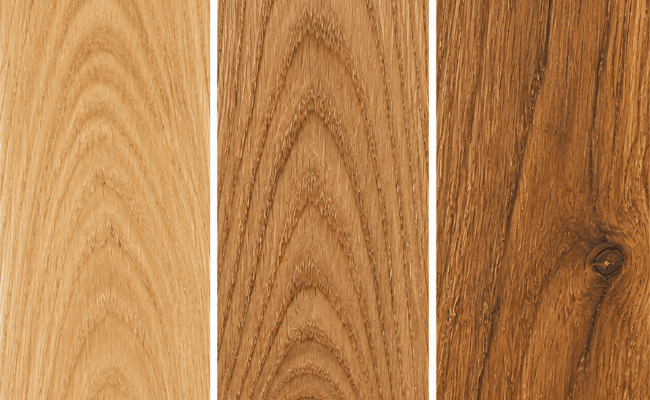
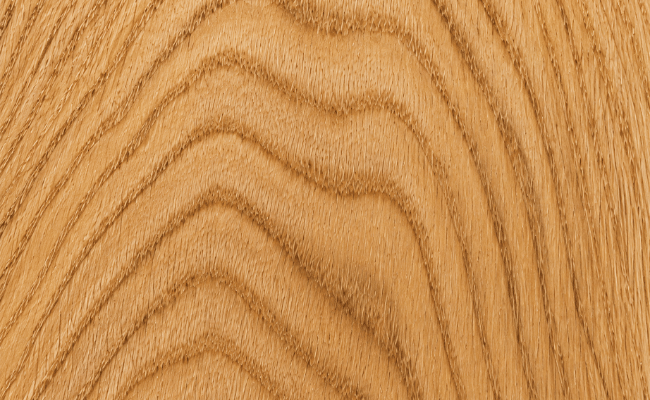
One of the most recognisable characteristics of European oak is its strong natural grain.
Its heartwood is typically yellowish to medium brown, while the sapwood is lighter. The annual growth rings are clearly visible, and the combination of earlywood pores, denser latewood and broad rays gives European oak much of its characteristic appearance.
The exact appearance can vary considerably between boards. This variation is influenced by growing conditions, grain orientation, natural characteristics and the way the log has been converted.
Colour and grain
European oak generally has a warm, natural colour ranging from lighter yellowish-brown tones to deeper brown shades.
The grain is commonly straight but can show natural irregularity. Growth rings are usually clearly defined, producing the recognisable grain patterns associated with oak.
Rather than treating these variations as automatically positive or negative, they should be assessed according to the visual requirements of the finished component.
Heartwood and sapwood
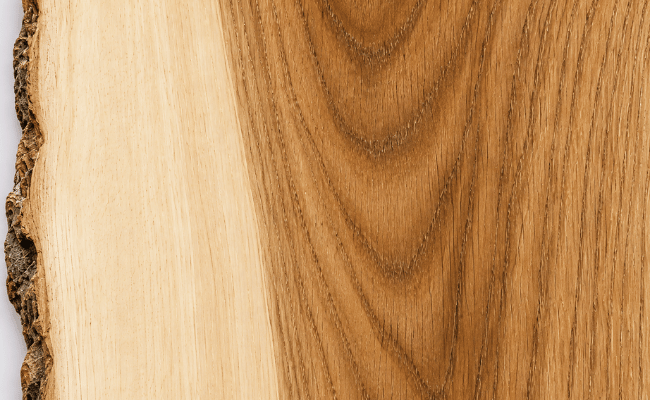
The heartwood forms the inner part of the trunk and is normally darker in colour.
The sapwood lies towards the outside of the trunk and is generally paler.
The distinction is not only visual. Natural durability ratings primarily relate to the heartwood, while sapwood does not provide the same level of natural resistance.
For specification purposes, it is therefore important not to assume that every part of an oak board has identical durability characteristics.
Medullary rays and the effect of sawing
Medullary rays are natural bands of cells running radially through the tree. European oak has particularly broad and visible rays.
Their appearance depends strongly on the orientation in which the timber is cut.
On quarter-sawn surfaces, these rays can produce the distinctive flecks or silver-grain figure associated with oak. TDUK specifically identifies this visible ray figure as a characteristic of quarter-sawn European oak.
How does European oak perform?
European oak combines relatively high density, good mechanical properties, natural durability in the heartwood and a distinctive visual structure.
1. Strength and wear resistance
European oak is also a relatively dense hardwood, which contributes to its resistance to wear and its substantial feel as a material.
Performance still depends on the individual timber, however. Moisture condition, grain direction, dimensions and natural characteristics can all affect the behaviour of a finished component.
2. Natural durability
European oak heartwood has useful natural durability, but this property should be interpreted carefully.
Natural durability does not mean that every piece of European oak is automatically appropriate for every environment. Sapwood has lower durability, while exposure to moisture, component design, ventilation and service conditions also influence long-term performance.
The behaviour of European oak in historic structures also shows that durability in practice depends on more than the timber itself. Design, moisture exposure, ventilation and maintenance all play an important role in how oak performs over time.
The correct question is therefore not simply whether European oak is “durable”, but whether the material and specification are suitable for the conditions in which it will be used.
3. Moisture behaviour
European oak, like all timber, is hygroscopic. It exchanges moisture with the surrounding environment and changes dimension as its moisture content changes.
TDUK classifies European oak as having medium moisture movement.
For manufacturers and specifiers, this means that drying and moisture condition need to correspond with the manufacturing process and the environment in which the finished component will ultimately be used.
Moisture condition is therefore an important part of timber performance, and understanding how moisture content affects the stability and performance of European hardwoods can help reduce dimensional problems during manufacturing and in service.
Is European oak easy to work and finish?
European oak can be successfully machined and finished, although its working characteristics vary according to density, growth conditions, grain orientation and drying quality.
Sharp tooling is important, particularly where cross grain or highly figured quarter-sawn material is present. European oak can be stained, polished, waxed and glued satisfactorily, although pre-drilling may be advisable close to edges when using screws or nails. l
Its pronounced grain also responds well to finishing, allowing the natural texture to be emphasised or the colour to be modified according to the required result.
One particular characteristic needs attention: oak contains tannins.
Iron coming into contact with oak, particularly in the presence of moisture, can react with these tannins and produce dark staining or discolouration. Appropriate handling, tooling and fixings are therefore important where visual appearance is critical. This effect is sufficiently important that TRADA case-study guidance specifies stainless-steel fixings to avoid iron staining in exposed oak
What should you consider when selecting European oak?
Selecting European oak should begin with the requirements of the finished component rather than with the species name or visual grade alone. Several factors should be considered together:
- Appearance. How much colour, grain and natural variation is acceptable?
- Cut and grain orientation. Is a particular grain pattern or visible ray figure required
- Moisture condition. Is the timber appropriately conditioned for manufacturing and for the final environment
- Natural characteristics. Which knots, colour variations or other natural features are acceptable?
- Dimensions. What dimensions allow the required components to be manufactured efficiently
- Machining requirements. How will the timber be sawn, planed, moulded, drilled, glued or finished?
- Yield. How much of the supplied timber can realistically be converted into usable finished components?
These factors are closely connected. In particular, how European hardwood grades are assessed and specified can directly affect appearance, usable yield and material efficiency. A more selective grade is not automatically the best choice; the right specification is the one that balances the visual and technical requirements of the finished component with an acceptable manufacturing yield.
What are the advantages and limitations of European oak?
European oak offers a useful combination of visual and technical characteristics, but a good specification should consider its limitations as well as its advantages.
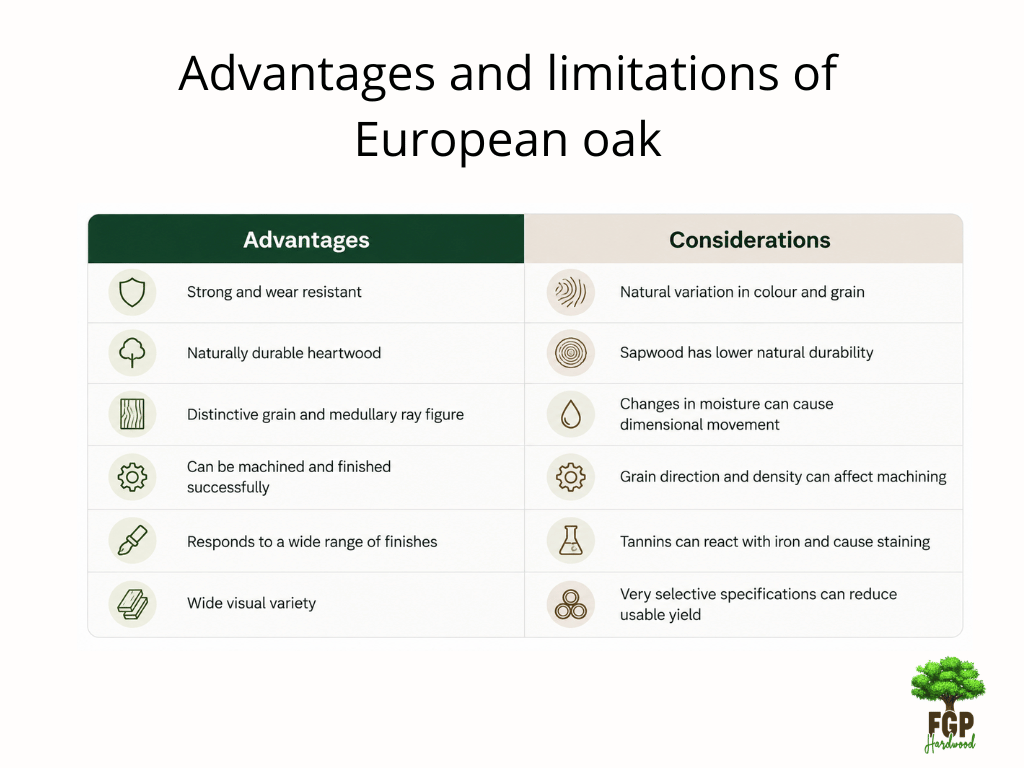
This balance is important. European oak should not be specified simply because it is considered a premium or attractive hardwood; its characteristics need to match the manufacturing process, appearance requirements and final use.
Frequently asked questions
Is European oak a hardwood?
Yes. European oak is a temperate hardwood. In the European timber market, the term generally refers mainly to Quercus robur and Quercus petraea.
What is the density of European oak?
Density can vary depending on species, origin and growing conditions. As a general reference, dried European oak typically falls within a range of approximately 670–720 kg/m³. For this reason, a range is more accurate than treating a single figure as a universal value.
What is the natural durability of European oak?
European oak heartwood has good natural durability, while the sapwood is less durable. Long-term performance also depends on moisture exposure, environmental conditions and component desig
What colour is European oak?
European oak typically ranges from pale yellowish-brown to medium brown, although natural variation occurs between boards. The sapwood is generally lighter than the heartwood, while grain pattern and sawing direction can also influence its appearance.
How does European oak respond to moisture?
European oak absorbs and releases moisture depending on the surrounding environment. These changes can cause the timber to expand or contract slightly, so its moisture content should be appropriate for both the manufacturing process and the conditions in which the finished component will be used.
If you are evaluating European oak for a project and need guidance on specification or supply requirements, we can help you assess the most suitable options for your application
Don’t forget to follow FGP Hardwood on LinkedIn for more insights on European hardwoods, sourcing and timber specification.