

Defects in European hardwoods do not always become costly problems because of their size or severity, but because they are not properly identified, interpreted, or managed throughout the supply chain.
To reduce claims and avoid unnecessary losses, it is essential to understand which defects are most common in European oak, beech, and ash. It is equally important to assess how they affect yield, usability, and commercial acceptance. Prevention matters just as much.
Why defect identification matters
European hardwoods are natural materials, and variation is part of their value. However, not all variation is acceptable in every application. What may be tolerable in one end use can become a major issue in another, especially when appearance, machining performance, dimensional stability, or grading consistency are critical.
For importers, distributors, manufacturers, and project buyers, defect identification is not only a quality matter. It directly affects usable yield, production efficiency, grading acceptance, project suitability, and claim exposure. When defects are not properly identified or interpreted, they often lead to disputes. In many cases, these issues could have been avoided with clearer specifications and better technical alignment.
The most common defects in European hardwood
Understanding the most common defects in European hardwoods is essential, since even relatively small issues can influence material performance, grading acceptance, and the overall value of a shipment.
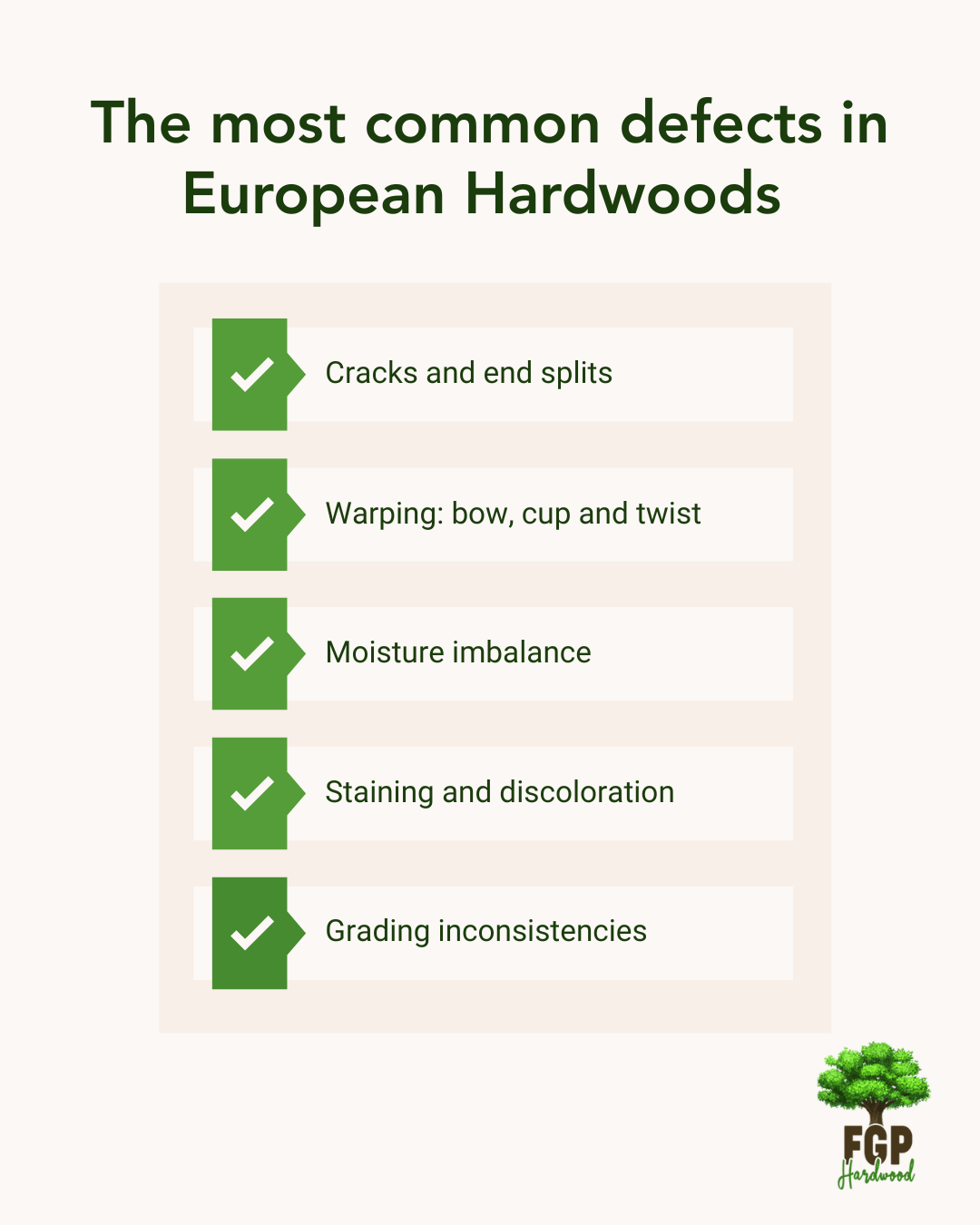
1. Cracks and end splits
Cracks and end splits are among the most frequent defects in hardwoods. They usually appear when moisture is lost too quickly, particularly at the ends of boards, where drying is more rapid.
These defects reduce usable material, lower recovery in cutting plans, downgrade boards in appearance applications, and increase trimming and waste. They are usually caused by drying that is too rapid or poorly controlled, inadequate end protection, internal tension released during processing, or poor storage conditions after drying.
2. Warping: bow, cup and twist
Warping is one of the most costly defects because it affects processability as much as appearance. Even if a board is technically acceptable in grade, deformation can make it difficult or inefficient to use.
Warping can create machining and calibration difficulties, affect assembly and gluing, reduce dimensional accuracy, and increase labour, rework, and rejection risk. It is commonly linked to uneven drying, residual internal stress, poor stacking, unstable storage humidity, or an imbalance between board cut and moisture behaviour.
3. Moisture imbalance
Moisture imbalance is one of the most decisive quality variables in hardwoods. In many cases, a board may look acceptable on arrival. However, if its moisture content is too high, too low, or unevenly distributed, problems are likely to appear later.
Moisture imbalance can lead to dimensional movement, opening joints, surface checking, instability in service, and, in unsuitable conditions, mould risk. It is generally caused by insufficient drying time, poorly controlled kiln cycles, poor equalisation, moisture reabsorption during storage or transport, or a mismatch between target moisture content and the final use environment.
4. Staining and discoloration
In addition, staining and discoloration can affect the commercial value of hardwood even when the board remains structurally usable. In many markets, especially for visible interior applications, colour consistency is a key requirement.
These issues can downgrade visual grades, reduce suitability for premium uses, make board matching more difficult within the same project, and increase rejection in design-led applications. They are often related to improper storage, excessive humidity, fungal activity, contact marks during stacking, or reactions linked to drying or handling conditions.
Not all colour variation is a defect, of course. Natural tonal differences are expected in wood. The real challenge is distinguishing acceptable natural variation from commercially unacceptable staining.
5. Grading inconsistencies
Grading inconsistencies often create disagreement over price versus value. They also increase sorting losses at destination, reduce recovery from the shipment, and lead to commercial claims and unnecessary friction. They usually result from unclear specifications, different interpretations of the agreed grade, lack of alignment on visual expectations, or insufficient communication before shipment
6. Handling and packaging damage
Not all defects originate in the wood itself. Some appear during loading, transport, unloading, or storage. Broken edges, forklift marks, pressure damage from strapping, and poorly protected packs can all reduce the value of the material.
Handling and packaging damage can cause localised loss of usable volume, hide defects inside the pack, increase sorting and rework time, and create disputes over responsibility. It is typically caused by insufficient pack stability, poor protection during loading, improper forklift handling, or movement and compression during transport.
How defects lead to costly claims
Claims rarely result from one issue alone. In most cases, they arise when technical defects, unclear specifications, and insufficient documentation come together.
A crack may be acceptable in one grade and unacceptable in another. A moisture deviation may be manageable for one end use but not for another. Staining may be tolerated in structural applications but rejected in visible interior projects.
For that reason, the commercial impact of defects does not depend only on the defect itself, but also on the agreed specification, the intended final use, the grading standard applied, and how clearly the material was documented before shipment.When these points are not properly aligned, even relatively small technical issues can turn into costly claims.
How to prevent costly claims
Preventing costly claims starts long before delivery. In most cases, it depends on process control, technical alignment, and realistic expectations on both sides.

Clear specifications and grading alignment
Preventing claims starts with clear specifications and a more consistent approach to quality requirements. Before production or shipment, buyer and supplier should align on the species, grade, target moisture content, dimensions and tolerances, sapwood allowance, and expectations linked to the final application. The clearer the specification, the lower the risk of later disagreement.
At the same time, many disputes come from different interpretations of the same grade. For that reason, consistency in grading is essential, especially in applications where appearance has a direct impact on acceptance and value.
Process control and documentation
A significant part of defect prevention depends on process control, especially in drying, storage, handling, and documentation. Correct kiln drying and proper equalisation help reduce defect risk. Stable storage humidity, correct stacking, and proper protection matter as well before the material reaches the customer.
Documentation also matters. Photos, pack identification, moisture records, and shipment documents reduce ambiguity and make it easier to clarify responsibilities if a question or claim arises later.
Finally, the same board may be acceptable for one use and unsuitable for another. For this reason, defect evaluation should always consider the final application rather than relying only on a general grade description.
Why defect control is a business issue
Defects in European hardwoods are part of working with a natural material, but costly claims usually arise when those defects are not properly understood, specified, or managed.
Cracks, warping, moisture imbalance, staining, grading inconsistencies, and handling damage all affect yield, processing efficiency, and final product quality. When expectations are unclear or defect impact is underestimated, the result is often avoidable loss, delay, and commercial friction.
For buyers, distributors, and manufacturers, the objective is not to eliminate all variation, but to identify the defects that matter, understand their real impact, and prevent them through better specifications, process control, and supplier alignment. A more structured approach to defect management leads to better recovery, fewer claims, and more reliable hardwood supply.
Discover more insights from the world of wood follow us on Linkedin and stay up to date with trends, certifications, and sourcing tips from FGP Hardwood.