In a demanding market, traceability and responsible forest management are true commercial differentiators. Ordering certified European hardwoods —FSC® or PEFC— turns compliance into a competitive advantage for public works, contract, and retail, strengthening client trust and protecting brand reputation.
What FSC® and PEFC certify (B2B reality)
FSC® (Forest Stewardship Council®) and PEFC (Programme for the Endorsement of Forest Certification) verify two complementary dimensions:
- Responsible origin at the forest (legality, environmental and social criteria).
- Chain of Custody throughout the supply chain so the certification claim that reaches your warehouse is traceable and accurate.
These schemes do not speak to visual/technical grade (that’s QF/QPA/A–B–C); they prove origin and documentary control. When your purchase order includes oak, beech, or ash with certification, the supplier assigns the material to a certified flow and keeps it under control through delivery and invoicing.
How that translates to your purchase end-to-end:
- Purchase order with a defined claim (e.g., FSC Mix Credit or PEFC Certified), plus species, format, and grade.
- Internal assignment & control of the certified lot (labels; segregation when required).
- Delivery note reflecting the same certification claim.
- Invoice including the certification statement and the supplier’s CoC code.
Result: what you quote and deliver to your client matches what you can evidence in an audit or document review.
Chain of Custody (CoC): what your documents must show
CoC ensures the “certified” volume sold corresponds to certified volume managed by the supplier. You verify it through document consistency:
-
- Lot identification on PO, delivery note, and invoice.
- Same certification claim across all documents.
- Traceable data: species, format, volume, and references linking PO and delivery.
- Supplier CoC certificate code and applicable scope.
This continuity reduces compliance risk, prevents paperwork issues, and builds trust with clients who need proof of origin.
FSC® or PEFC? Choose by project specs and scope
Both schemes ensure responsible management and document control, with international recognition. The choice is usually set by tender specs or the end-client’s policy.
- If both are accepted, prioritise availability and lead time.
- If one is mandatory, check the required scope (e.g., FSC 100%, FSC Mix, PEFC Certified) and the supplier’s certificate validity.
Operational tip: confirm in writing which scheme and scope (100%/mix) are accepted to avoid rework or missing delivery windows.
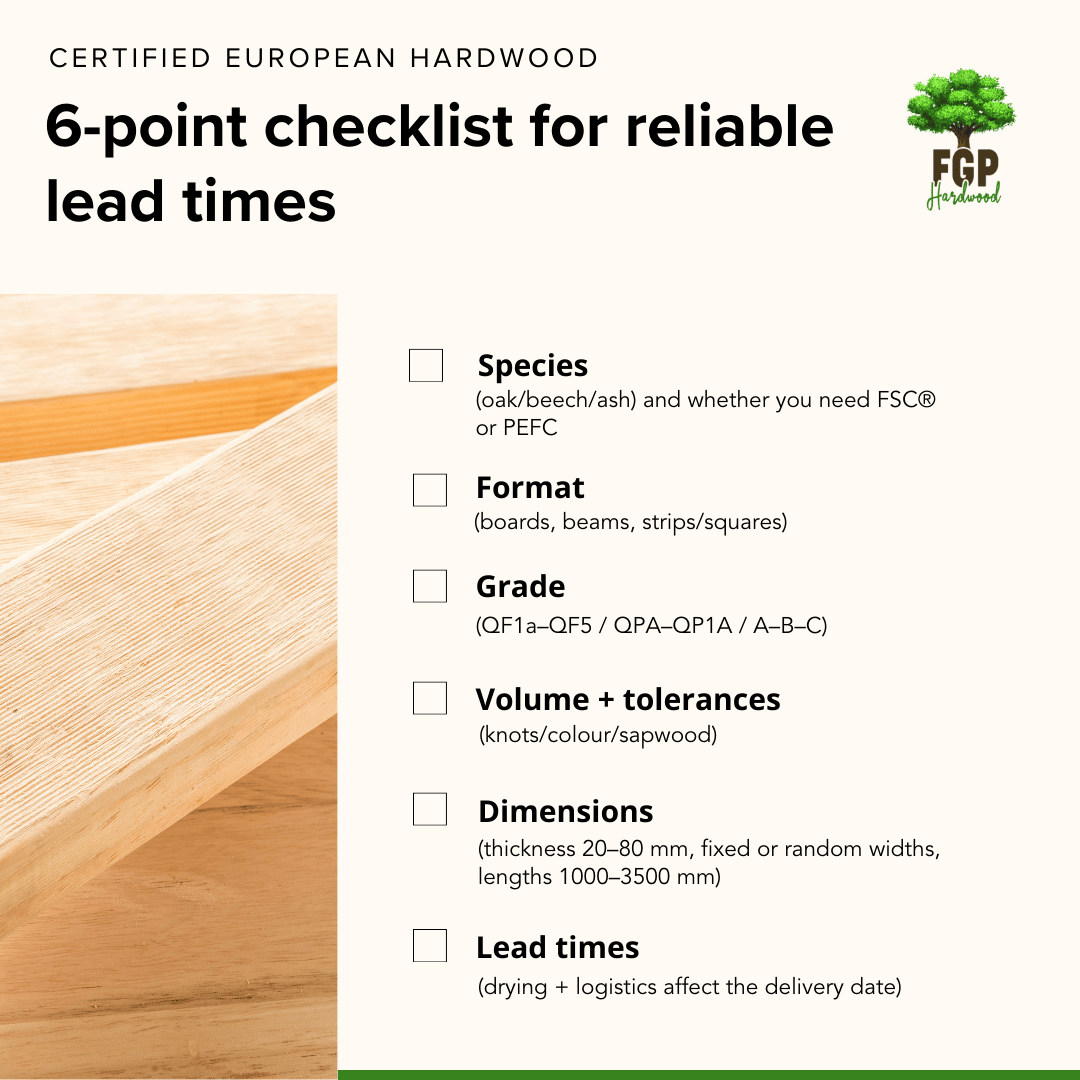
How to request certified timber without delays (step-by-step)
Although European oak drives most demand, European beech and European ash are key allies for their stability, workability, and finishing capability:
- Species & format. Define oak / beech / ash and boards / beams / friezes-squares.
- Grade. Specify QF1a–QF5 (boards), QPA/QP1A (beams) or A/B/C (friezes).
- Dimensions. Thickness (e.g., 20–80 mm), fixed or random widths, lengths (e.g., 1000–3500 mm); for beams, section (150×150, 200×200, 100×100).
- Certification claim. Add “FSC®” or “PEFC” with the exact label your supplier can issue.
- Documents. Require the certification statement and CoC code on the delivery note and invoice.
- Lead times. Build drying and logistics into your target date; for 27/40/52 mm, reserve capacity in advance.
If you need European oak, beech, or ash with FSC® or PEFC certification, FGP Hardwood helps you structure your order from start to finish — defining grades, optimizing dimensions, preparing documentation, and scheduling realistic timelines. We combine certified European supply with international logistics to ensure reliability. Tell us your required sizes and grades, and we’ll propose the best balance of quality, price, and lead time for your project.
Discover more insights from the world of wood follow us on Linkedin and stay up to date with trends, certifications, and sourcing tips from FGP Hardwood.