
Comparing European hardwood quotes is not as simple as checking which supplier offers the lowest price per cubic metre. In many cases, two quotes that look similar on paper can lead to very different results in terms of yield, usability, processing efficiency, and final cost.
For buyers, importers, distributors, and manufacturers, the real price of European hardwood is shaped by much more than the number shown in the quotation. Grade, moisture content, dimensions, sapwood allowance, average lengths, machining quality, packaging, and transport conditions all influence the actual value of the material delivered.
Understanding how to compare European hardwood quotes properly helps reduce misunderstandings, improve purchasing decisions, and avoid costly problems later in the supply chain.
Why price per m³ is not the full picture
The price per cubic metre is an important reference point, but it does not tell the full commercial story. A lower nominal price may seem attractive at first, yet the real value of the quote depends on how much usable material the buyer will actually recover from the shipment.
If one quote offers a lower price but includes shorter lengths, wider tolerances, higher sapwood content, inconsistent grading, or moisture deviations, the apparent saving may disappear once the material is processed. By contrast, a higher quote may deliver better recovery, more stable production, and fewer downstream issues.
For that reason, comparing quotes only by headline price can lead to poor purchasing decisions.
The key factors behind the real price of European hardwood
Several technical and commercial factors influence the real value behind the m³, which is why buyers should look beyond the quoted price alone.
Grade, moisture content, dimensions, average lengths, expected recovery, species suitability, and delivery conditions all shape the final value of the material once it reaches production or installation.
1. Grade and visual quality
Grade has a direct impact on the real value of the material. Two suppliers may both quote European oak, beech, or ash, but the quality delivered can vary significantly depending on the grading rules applied and the interpretation of those rules.
A lower price may reflect a lower visual grade, higher sapwood allowance, more knots, more colour variation, or a greater presence of defects that reduce the amount of usable material for the intended application.
If you need a broader reference on this point, you can also read our article on European hardwood grades.
2. Moisture content
Moisture content is one of the most important technical factors behind the real price of hardwood. Material that is not dried to the correct range for its final use may create movement, instability, machining issues, or problems during installation.
A cheaper quote does not necessarily represent better value if poor moisture control later leads to waste, rework, delays, or claims. The target moisture content should always be considered in relation to the final application, storage conditions, and manufacturing process.
3. Dimensions, tolerances, and average lengths
Quotes should not be compared only by species and grade. Dimensions, thickness consistency, width mix, length range, and tolerances all affect how efficiently the material can be used.
Shorter lengths may lower the quoted price, but they can also reduce yield depending on the cutting plan. Wider tolerances may appear acceptable at first, yet they can increase sorting time and reduce production efficiency. A quote with better dimensional consistency may be commercially stronger even at a higher nominal price.
4. Yield and recovery
The real price behind the m³ is closely linked to yield. What matters is not only how much volume is bought, but how much usable material remains after trimming, sorting, processing, and selection.
For example, a shipment with more end splits, warping, staining, or grading inconsistencies may look competitive in quotation form, but it can reduce recovery and increase effective cost once in production.
This is why buyers should always compare quotes in terms of likely recovery, not only nominal volume.
5. Species suitability for the final use
European oak, beech, and ash do not offer the same balance of appearance, machinability, strength, and application suitability. A quote should therefore be assessed not only on price, but also on whether the species fits the intended project.
In some cases, a buyer may compare a lower-cost species with a more established one, but the lower quote may not represent better value if the final application requires different mechanical or visual characteristics.
6. Packaging, transport, and delivery conditions
The real value of a quote also depends on what happens beyond the material itself. Packaging quality, load stability, protection during transport, delivery terms, and handling conditions all influence the final condition of the wood.
A competitive quote may become less attractive if poor packaging or weak transport conditions increase the risk of damage, moisture variation, or claims on arrival. Delivery reliability and communication should also form part of the evaluation.
How to compare hardwood quotes more effectively
A better quote comparison starts with a clearer purchasing structure. Instead of asking only which supplier is cheaper, buyers should ask which quote offers the best balance between price, yield, technical suitability, and commercial reliability. A practical comparison should include the exact species, the agreed grade, moisture target, dimensions and tolerances, average lengths, sapwood allowance, packaging details, delivery terms, and expected recovery for the intended application
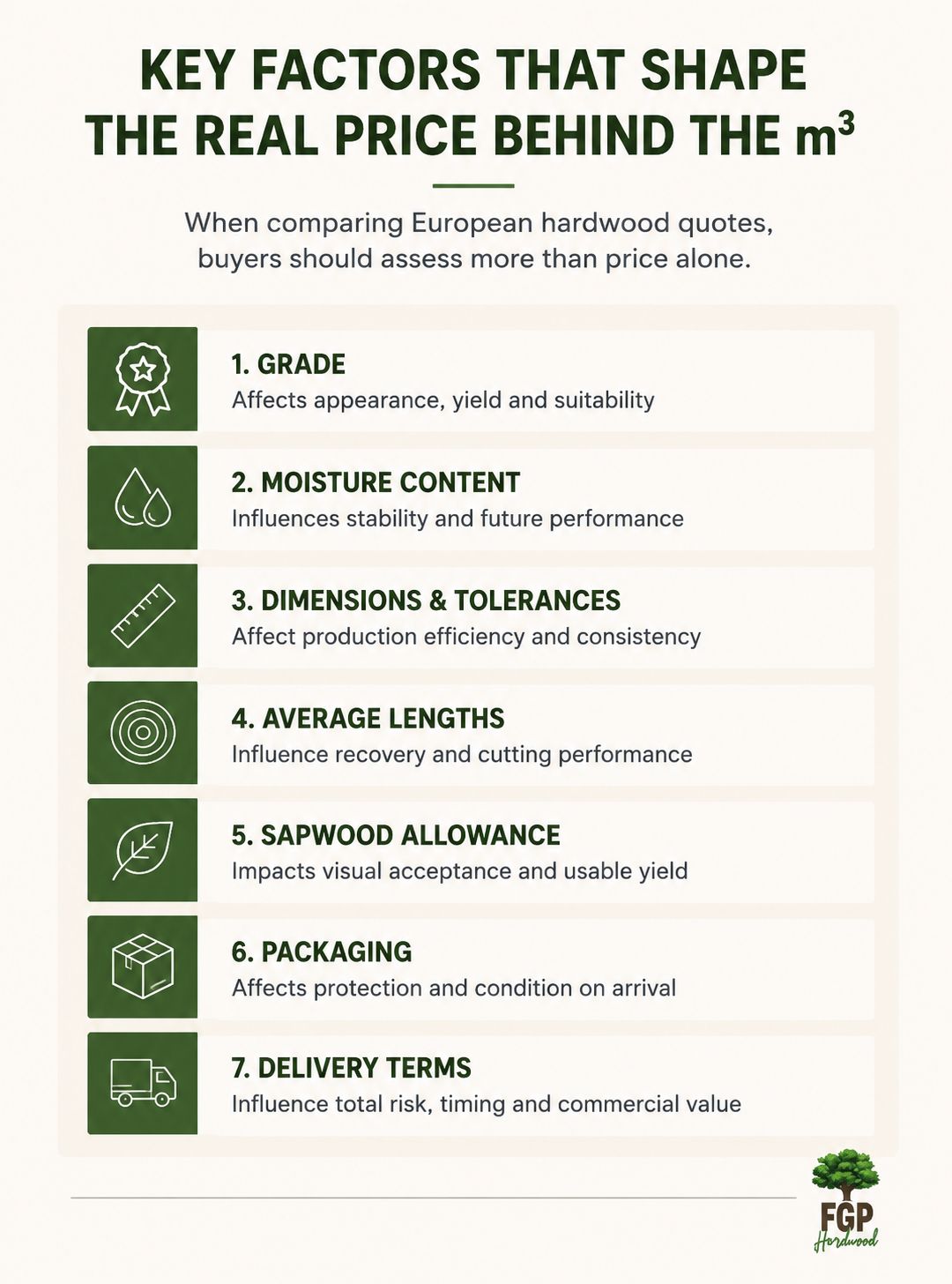
When these points are not aligned, quotes can look comparable while actually referring to very different material realities.
Questions buyers should ask before choosing a quote
Before confirming a purchase, buyers should clarify a few essential points. What grade standard is being applied? What moisture range is guaranteed? Are average lengths realistic for the final use? How much sapwood is acceptable? What packaging and loading conditions are included? Are dimensions consistent enough for the intended process? How likely is the material to generate sorting losses or production inefficiencies?
These questions help reveal the real price behind the m³ and reduce the risk of false savings
Why the cheapest quote is not always the best quote
A low headline price can be attractive, especially in competitive purchasing environments. However, hardwood buying decisions should not be driven only by the nominal cost per cubic metre. When grading is inconsistent, moisture control is weak, lengths are too short, tolerances are too broad, or packaging is poor, the real cost of the material increases later. That cost may appear as waste, extra labour, reduced recovery, delayed production, or commercial claims. For that reason, the cheapest quote is not always the most economical choice.
Comparing European hardwood quotes correctly means looking beyond the price per m³. Grade, moisture content, dimensions, lengths, recovery, packaging, delivery conditions, and species suitability all shape the true value of the offer.
For buyers, importers, distributors, and manufacturers, the objective is not simply to secure the lowest quoted price, but to understand which quote offers the best overall result for the final application and the supply chain behind it.
A more structured comparison process leads to better purchasing decisions, more predictable recovery, fewer surprises in production, and a more reliable hardwood supply.
Discover more insights from the world of wood follow us on Linkedin and stay up to date with trends, certifications, and sourcing tips from FGP Hardwood.